HYPE WEIGHS YOU DOWN. SHOES SHOULDN'T
Fit > Flex. Every. Single. Time.
3/5/20264 min read
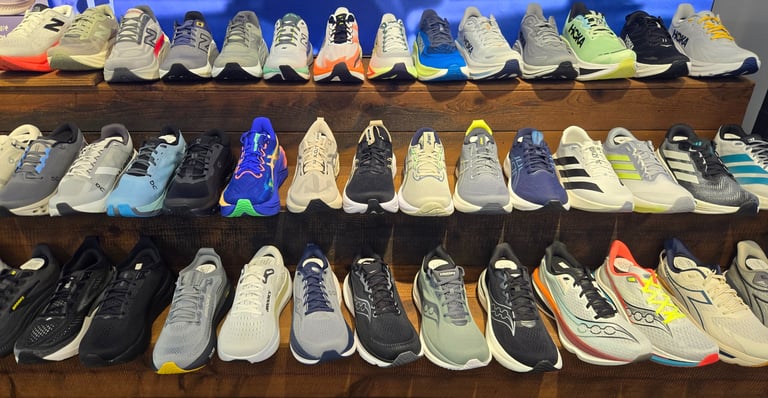
You walk into a running store. Walls stacked with shoes. Neon colors everywhere. Price tags make you blink twice.
Someone asks what you're looking for.
No cap, no clue.
Because somewhere in the back of your mind the number sounds completely ridiculous.
Twenty-six point two miles.
You can’t even run one mile without your lungs burning. Legs feel like concrete. And your brain? Three minutes in it’s already tapping you on the shoulder negotiating your surrender.
But here’s the flex: you ignore it.
You just start.
You push.
You tell your legs to shut up.
Then somewhere in the hundreds of hours training, that impossible beast becomes just another Sunday long run.
Almost nobody starts out believing they can ever run a marathon.
I didn’t. But then I did it.
AFTER MY FIRST MARATHON?
I got a job at a running store.
Not for the paycheck.
For the knowledge. Community. And yeah, maybe the discount on shoes.
Two years. Fitting hundreds of runners. Beginners. Ultra veterans. Carbon plate junkies chasing milliseconds. Tying dozens of pairs myself. I picked up a ton about shoes. And here’s the truth:
It doesn’t matter if you’re starting running, been running for years, or couldn’t care less about running. This matters if you have feet.
THE MOST COMMON MISTAKE I SAW
Running shoes aren’t boots. Not dress shoes. If you’re buying your casual size? Wrong. Half a size up, maybe a full.
Feet swell. Flatten. Spread. You need space.
A thumb’s width between your longest toe and the end of the shoe.
Not “feels snug.” Not "just touching the end."
Actual space.
Otherwise? Congrats. You signed up for blisters. Black toenails. Bunions. Calluses.
None of that is “just part of running.” That’s bad fit.
I saw it every day in the store. People walking in with toes jammed against the front of their shoes, wondering why their feet hurt.


OTHER TRAPS
Buying shoes based on brand. Stop it.
Hoka? Our top selling brand. Also top returned. Great shoes. May be perfect for your friend. Not necessarily for you.
And every brand makes dozens of models. Designed for different purposes.
Influencers praising “holy grail” shoes? They’re selling products. You’re trying to run pain-free. That’s not the same thing.
Brand doesn’t matter. Model does. Fit does. Your goals do.
HOW TO CHOOSE A RUNNING SHOE
Results > style. Match the tool to the job.
Midsole game: You’re choosing your vibe.
Light Cushioning: Speed demons. Fast, snappy, lightweight. Perfect for intervals, short races, and runners who want to feel the pavement talk back.
Moderate Cushioning: Everyday workhorse. Solid shock absorption, some bounce. Daily trainer, tempos, long runs, marathons. Just lace up and cook.
Max Cushioning: Luxury mode. Recovery days, long runs, ultras. Great for heavier runners or pounding concrete.
Responsiveness (aka the bounce test). How fast the shoe snaps back after you compress it.
Good energy return = little spring in every stride.
Bad energy return = you sink in and gotta fight your way out.
Nobody wants quicksand shoes.
Midsole Drop: Set your angle.
High Drop (8–12mm): Heel’s riding high. Cushy landings, less Achilles & calf strain. Great for heel strikers and beginners.
Medium Drop (4–8mm): Balanced vibes. Works for most runners. Smooth transition if you’re switching up.
Low Drop (0–4mm): Flatter platform. Midfoot or forefoot strike encouraged. Builds calf & lower-leg strength over time. Altra and Inov-8 fans know.
Zero Drop: Heel = forefoot. Barefoot vibes. Pure connection to the pavement. Take it slow or your calves will remind you.
Pro tip: Your body adapts. Comfortable & pain-free? Keep rocking it. Something hurts? Swap the drop and shift the load.
Upper Fit: Length, width, instep height. Snug. Not hostage-level tight.
Get the measurements right, then tweak for comfort.
Pressure Pattern and Arch Flex: Where do you load pressure? Medial? Lateral? Neutral? Rigid or flexible arch?
If you’ve got medial pressure or flexible arches, stability shoes might be your squad.
ADDITIONAL SUPPORT
Neutral vs Stability Shoes:
Neutral: Minimal structure. For arches with no excessive inward or outward roll.
Stability: Guides mild overpronation. Not “fixing” you. Just supporting how your foot moves.
Overpronation isn’t a flaw. It’s just your foot doing its thing.
Arch support:
Sock liners = lowest common denominator, minimal to no support.
Insoles = game changer. Align knees, hips, ankles. Take pressure off plantar fasciitis.
Turn a decent shoe into a great one. Start with the right shoe. Then fine-tune support.


FINAL CALL
Running isn't just exercise. It's a conversation with yourself.
Step after step.
No shortcuts.
You learn things out there. About patience. About showing up when it's easier not to. About what you're capable of.
And you learn that the right shoes matter. Not the hype. Not the logo. Just something that fits your feet and lets you keep going.
So 10-minute or 10-mile runner, don’t just chase the 'gram drip.
Buy what works for your feet, your miles, and your goals. Replace them when they're dead (300–500 miles). And for God's sake, don't buy them because your friend or someone on TikTok said so.
Photo: Martin Sanchez
Photo: Shengpengpeng Cai
Thumbnail photo: Kindel Media
Contact
Questions or thoughts? Reach out anytime.
hello@cutandkept.com
© 2026. All rights reserved.